

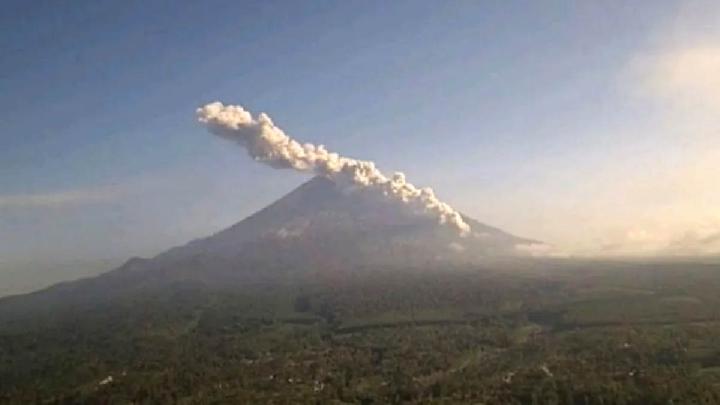
Jakarta, ThedailyID — Mount Semeru in East Java erupted six times on Thursday, November 5, 2026. Thick volcanic ash and pyroclastic flows triggered panic among nearby residents and sand miners.
Amateur footage showed workers and truck drivers fleeing a sand mining site near the volcano. Several people quickly turned their vehicles around as a massive ash column rose above them.


At least seven trucks, one heavy machine, and several motorcycles were seen leaving the area. The person recording the footage also shouted warnings, urging everyone to escape.
Similar scenes unfolded in nearby residential areas. Residents warned people working near river channels to move to higher ground immediately as hot clouds traveled down the slopes.
Muhammad Amrul, head of the East Java Disaster Management Agency’s Operations Control Center (Pusdalops), reported three pyroclastic flows by noon local time. The flows traveled between 3,000 and 4,500 meters from the summit toward the southeast.
“The pyroclastic flows moved toward the southeastern sector of Besuk Kobokan,” Amrul said.
Meanwhile, authorities had not reported any casualties or damage at the time of the announcement. The disaster management agency was still collecting information from affected areas.
Earlier that morning, Mount Semeru erupted at 9:24 a.m. local time, sending an ash column approximately 700 meters above its summit. The eruption also produced a pyroclastic flow that traveled around 4,500 meters southeast.
Sigit Rian Alfian, an officer at the Mount Semeru Observation Post, said the ash appeared gray to black and was thick. It drifted toward the south and southwest.
Seismograph recordings showed a maximum eruption amplitude of 31 millimeters. The eruption lasted seven minutes and 27 seconds.
Semeru remains at Alert Level III, or Siaga. Therefore, authorities have urged residents and sand miners to avoid the southeastern sector along the Besuk Kobokan River for up to 13 kilometers from the eruption center.
Authorities have also instructed people to stay outside a five-kilometer radius from the crater. This restriction aims to reduce the risk of injury from volcanic rock ejections.
Officials warned that further pyroclastic flows could occur at any time. Residents and workers near the affected areas have been urged to remain alert and follow evacuation instructions.