
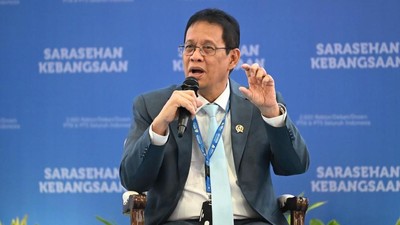
Jakarta, ThedailyID — Indonesia will direct about 80% of recipients of its Lembaga Pengelola Dana Pendidikan (LPDP), or Education Fund Management Agency, scholarships to science, technology, engineering and mathematics (STEM) fields starting in 2026. The government will also prioritize students pursuing strategic industries, Finance Minister Purbaya Yudhi Sadewa said.
Purbaya said the policy forms part of the government’s strategy to build a workforce that supports industrialization and strengthens Indonesia’s long-term competitiveness.


“Starting in 2026, around 80% of scholarships will focus on STEM and strategic industries,” Purbaya said during the 2026 Indonesian Science, Technology and Industry Convention (KSTI) at the Jakarta Convention Center on Sunday.
He said the priority sectors include food, energy, healthcare, digitalization, artificial intelligence, semiconductors, downstream industries, maritime and advanced manufacturing.
According to Purbaya, talent development remains a key pillar of Indonesia’s industrial transformation.
However, he said the government will continue combining STEM education with social sciences, humanities, arts, religion and economics (SHARE). He added that the approach will keep technological progress inclusive and sustainable.
Purbaya also said the state budget will continue supporting scientific research, technological innovation and talent development to strengthen Indonesia’s economic transformation.
Through the KSTI forum, he encouraged universities, research institutions and industry leaders to deepen collaboration. He said stronger partnerships would help produce evidence-based policies that support national development.
Meanwhile, the Finance Ministry continues expanding research partnerships with universities through the Center for Public Finance Research. The initiative aims to strengthen evidence-based policymaking.
Purbaya also said Indonesia’s economic fundamentals remain resilient despite global uncertainty.
The economy grew 5.61% in the first quarter of 2026. Annual inflation reached 3.08%. Purbaya attributed the performance to a trade surplus, healthy foreign exchange reserves, solid credit growth and continued manufacturing expansion.
“The government will continue maintaining economic stability through adaptive fiscal policies,” Purbaya said. “The state budget must protect the public from global risks while sustaining economic growth.”
He added that the 2026 state budget will prioritize food and energy security, education and healthcare. It will also support the Free Nutritious Meals program, village development, cooperatives, MSMEs, national defense, investment and trade as part of Indonesia’s Golden Vision 2045.