

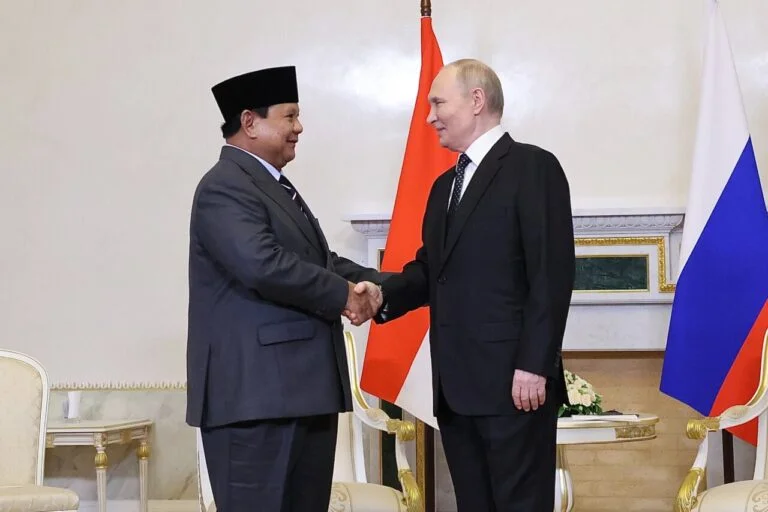
Jakarta, ThedailyID — President Prabowo Subianto is exploring plans to send Indonesians to join Russia’s cosmonaut training program, marking a potential step into human spaceflight collaboration.
Foreign Minister Sugiono said the idea emerged after Prabowo’s meeting with Vladimir Putin last week. He confirmed the discussion included cooperation in science, technology, and space exploration.


“President Prabowo conveyed the possibility of sending selected Indonesians to join Russia’s cosmonaut program,” Sugiono said on Wednesday, April 22, 2026, at the Presidential Staff Office in Jakarta.
He added that the plan aims to strengthen Indonesia’s human resources in high-tech sectors. According to him, the ability to send people or equipment into orbit reflects a country’s technological capability.
A cosmonaut is the Russian term for a space traveler, equivalent to an astronaut in the United States or a taikonaut in China. The program operates under Roscosmos.
Russia conducts its training at Star City, a historic facility near Moscow known for its rigorous preparation system. Candidates must pass strict physical, mental, and technical tests before entering the program.
Historically, the program dates back to the post–World War II era. The Soviet space program advanced rapidly using rocket technology developed during that period.
The program achieved major milestones, including the launch of Sputnik 1 in 1957 and the first human spaceflight by Yuri Gagarin in 1961. These events positioned the Soviet Union as a global leader in early space exploration.
The rivalry with the United States intensified during the Cold War. The US later surpassed the Soviet Union by landing Neil Armstrong and Buzz Aldrin on the Moon. Despite challenges after the collapse of the Soviet Union, Russia continues to play a key role in space missions. It operates the Soyuz program and collaborates on the International Space Station.
Sugiono emphasized that Indonesia’s participation remains at the exploration stage. However, the initiative signals a broader ambition to enter advanced space and technology sectors. If realized, the plan could open new pathways for Indonesian talent. It may also strengthen bilateral ties between Indonesia and Russia in science and innovation.