

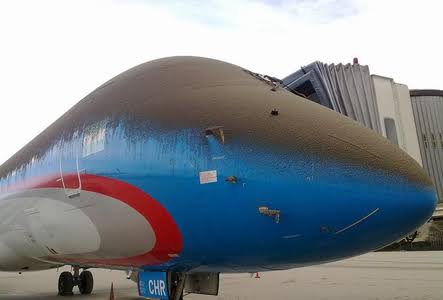
Jakarta, ThedailyID — Several flights at Indonesian airports were canceled from Sunday (06/09/2026) to Monday (07/09/2026) following the eruption of Mount Anak Krakatau. The eruption sent volcanic ash into the air and disrupted aviation operations.
But why is volcanic ash so dangerous for aircraft?


Disaster expert Daryono from the Indonesian Disaster Experts Association (IABI) explained that volcanic ash differs significantly from ordinary clouds. It contains microscopic rock fragments, silica and sharp mineral crystals that can severely damage aircraft.
“When an aircraft flies through an ash cloud at high cruising speed, the friction from these hard particles can mechanically erode cockpit windows until they become cloudy, damage air-data sensors such as pitot tubes that measure airspeed, and wear down turbine blades and protective layers inside jet engines,” Daryono said in a statement on Monday (07/09/2026).
The most serious risk occurs inside turbofan engines. Jet engine combustion chambers can reach temperatures of around 1,400 to 2,000 degrees Celsius, while silica in volcanic ash melts at roughly 1,100 degrees Celsius.
When an aircraft engine sucks in volcanic ash, the silica particles can melt and later solidify into glass-like deposits inside cooler turbine sections. These deposits can block airflow and disrupt turbine operation.
As a result, the engine can experience an engine stall and potentially a complete loss of combustion, known as flameout.
Volcanic ash can also interfere with aircraft navigation and electrical systems.
“In addition to mechanical and thermal damage, volcanic ash can also trigger systemic disruptions to aircraft navigation and electrical systems,” Daryono said.
The friction between airborne ash particles can also create strong static electricity. According to Daryono, this can cause St. Elmo’s Fire around cockpit windows and interfere with radio communications.
In addition, acidic compounds attached to volcanic ash can accelerate corrosion on sensitive electronic components. They can also contaminate cabin air-conditioning systems.
The Meteorology, Climatology and Geophysical Agency (BMKG) has also warned about the risks. The agency explained that volcanic ash consists of fine particles that winds can carry over long distances.
BMKG said the material can affect air quality, public health, the environment and transportation, including aviation.
“Volcanic ash contains glass fragments and sharp rocks. If sucked into a very hot aircraft engine, the ash will melt and clog the engine until it shuts down,” BMKG said in an Instagram post on Sunday (06/09/2026).
Volcanic ash can also reduce pilots’ visibility. The particles can scratch cockpit windows like sandpaper, making them cloudy.
Furthermore, ash can interfere with navigation by blocking aircraft sensors that measure speed and altitude. This can affect the accuracy of critical flight information.
For these reasons, airport closures and flight cancellations are considered important safety measures when volcanic ash reaches aviation routes or airport areas.