

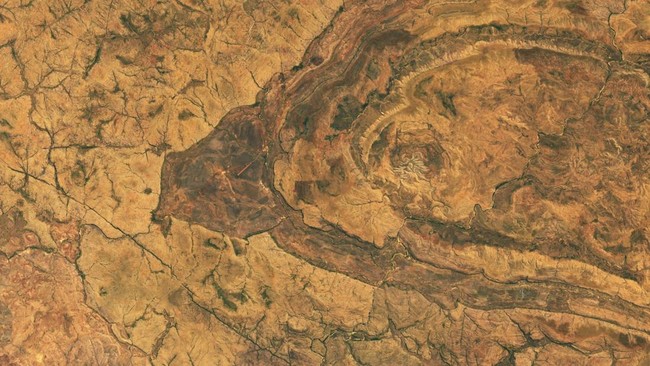
Jakarta, ThedailyID — NASA has captured an unusual spider-shaped geological formation stretching across the Kimberley region of Australia. Known as Spider Crater, the structure is believed to be the remains of an ancient meteorite impact.
The image was captured on September 20, 2026, by the Operational Land Imager (OLI) aboard Landsat 9, a satellite operated by NASA and the United States Geological Survey (USGS).


Spider Crater has an oval shape measuring approximately 13 kilometers by 11 kilometers. Its central spider-like formation spans around four kilometers.
Geologists believe the unusual pattern represents a central uplift, a section of the crater floor pushed upward as the ground rebounded after the initial impact.
The formation’s bright, leg-like features are sandstone ridges that remained after surrounding rock layers eroded away.
According to NASA Earth Observatory, scientists struggled for decades to explain how the formation developed after its discovery. Some researchers initially suspected the area had a volcanic history.
Field investigations later revealed distinctive evidence of an impact, including fan-shaped fractures known as shatter cones. These structures form when extremely powerful shock waves travel through rock.
“Such structures are found extensively throughout the central dome of Spider Crater,” NASA Earth Observatory said in a statement on October 13, 2026.
Scientists also conducted laboratory analyses of quartz and zircon crystals in the area’s sandstone. The minerals showed evidence of shock pressure, supporting the conclusion that a meteorite impact formed the crater.
NASA has not established the exact date of the impact. However, estimates based on the age of the surrounding rocks suggest the event occurred between 900 million and 600 million years ago, during the late Precambrian.