

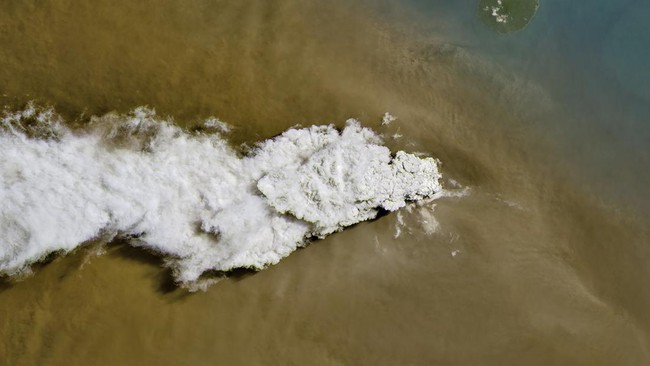
Jakarta, ThedailyID — NASA has released satellite images showing Mount Anak Krakatau during its explosive eruption on September 5, 2026.
Several satellites captured the volcano as the eruption continued for more than 24 hours. The event sent volcanic gas and ash high into the atmosphere.


An image from the Operational Land Imager (OLI) aboard the NASA-USGS Landsat 8 satellite shows a white plume of volcanic gas rising above a brown ash cloud.
Meanwhile, the Visible Infrared Imaging Radiometer Suite (VIIRS) aboard the Suomi NPP satellite captured volcanic material spreading across a much wider area.
“Satellites passing over the area during the September 5 eruption successfully captured images of the eruptive activity,” NASA said in a statement, Sunday, September 13, 2026.
NASA said Anak Krakatau erupts relatively regularly. However, most of its activity remains relatively mild.
This changed in early September 2026. The volcano, located between Java and Sumatra, showed stronger and potentially more dangerous activity.
According to NASA, citing Indonesia’s Meteorology, Climatology and Geophysical Agency (BMKG), volcanic ash reached around 6,000 meters east of the volcano and 15,000 meters westward on September 6.
The ash disrupted air travel across Java and Sumatra. Eight airports temporarily closed because of the volcanic material.
Media reports cited by NASA said the disruption affected nearly 3,000 incoming and outgoing flights.
The eruption also affected populated areas, particularly east of Anak Krakatau. Jakarta and parts of West Java experienced the impact of volcanic ash.
NASA also cited the Indonesian Humanitarian Coordination Platform (IHCP), which warned that volcanic ash can pose health risks. The particles can irritate the respiratory system, eyes and skin.
The explosive activity began to ease on September 6. However, volcanic activity continued afterward.
NASA said the eruption pattern later returned to a more typical Strombolian style. This type of eruption involves intermittent bursts of ash and volcanic material.
Affected airports gradually resumed operations on September 8. However, Anak Krakatau remained at the second-highest alert level in Indonesia’s national warning system.