
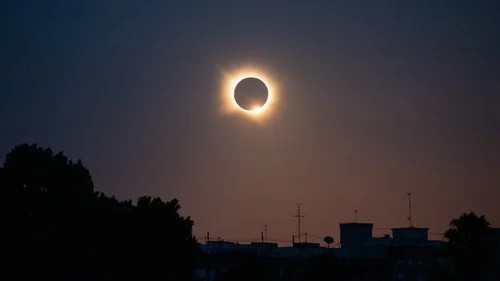
Jakarta, ThedailyID — Northern Spain fell into darkness on Wednesday, August 12, as a total solar eclipse crossed the region.
Millions of people gathered along the path of totality to witness the rare celestial event. The eclipse marked the first total solar eclipse visible in Western Europe in 27 years.


In Buitrago de Lozoya, north of Madrid, crowds cheered as sunlight faded shortly after 8:30 p.m. local time.
The Moon briefly blocked the Sun during the total phase. At the location, totality lasted for less than one minute.
Observers also saw Baily’s beads, small points of sunlight that appeared along the Moon’s edge before totality.
“Seeing the colors return little by little after totality was amazing,” economist Diego Fernandez, 32, told Reuters.
He said the colors shifted from red to blue, creating an effect similar to sunrise and sunset.
The eclipse also crossed Iceland shortly before reaching Spain. However, thick clouds obscured much of the phenomenon across the country.
In Reykjavik, the clouds blocked the eclipse itself. Still, the sky grew noticeably darker during totality.
Iceland, which has a population of about 400,000, welcomed up to 80,000 visitors for the event. Special eclipse glasses had also sold out days before the phenomenon.
The eclipse reached Iceland’s western coast at around 5:44 p.m. local time. Totality lasted for about two minutes and 13 seconds in the area.
Spain faced a much larger influx of visitors. The government estimated that up to 6 million people traveled to areas along the path of totality.
Authorities deployed around 25,000 police officers to secure viewing locations. Nearly 100 aircraft and helicopters also stood by because of the high wildfire risk.
Several fires were still burning across Spain on Wednesday. A major blaze affected Andalusia, while a smaller fire broke out near an eclipse viewing area in Peñíscola, Valencia.
The event also attracted dedicated eclipse chasers, who travel around the world to follow total solar eclipses.
The Iberian Peninsula last experienced a total solar eclipse in 1912. Another total eclipse will cross the region on August 2, 2027.
An annular solar eclipse will follow in January 2028. Together with the August 2026 eclipse, the events are known as the “Iberian Eclipse Trio.”