
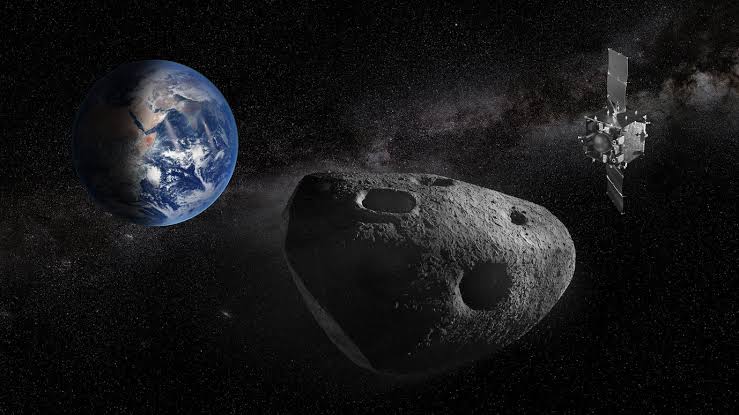
Jakarta, ThedailyID — The giant asteroid Apophis, roughly the size of a skyscraper, will make an exceptionally close flyby of Earth on April 13, 2029. Scientists estimate that up to 7.6 billion people, or about 90% of the world’s population, could witness the rare event with the naked eye.
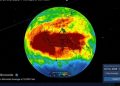
Retired cartographer Michael Zeiler and astronomer Rick Fienberg presented detailed visibility maps during the “Apophis T-3 Years” workshop at the University of Padua in Italy. Their calculations show that visibility will depend on local weather conditions and light pollution.


Unlike a bright meteor, Apophis will appear as a small point of light moving steadily across the sky. At its closest approach, it will move about the width of a full Moon every minute.
“Its motion will definitely catch people’s attention,” Fienberg said. “It moves more slowly than a satellite. It will cross the sky over several hours instead of minutes.”
The asteroid will remain visible for about seven hours. It will first appear above Australia before reaching its brightest point over Cameroon. At that stage, around 3.9 billion people across Africa, Asia, eastern South America, and parts of Europe could enjoy the best view.
Apophis will make its closest approach about 31,600 kilometers (19,600 miles) above the North Atlantic Ocean. That altitude is lower than the orbit of geostationary satellites. Around two billion people across much of South America, North America, Africa, and parts of Europe could witness the flyby.
Richard Binzel, a planetary scientist at the Massachusetts Institute of Technology (MIT), described the event as the first time humanity has accurately predicted the visible passage of such a large asteroid.
“This will be a shared experience for humanity,” Binzel said.
Scientists emphasize that Apophis poses no threat to Earth. When astronomers discovered the asteroid in 2004, early calculations briefly suggested a small chance of impact in 2029. However, more than two decades of observations refined its orbit. Researchers have now confirmed there is no collision risk in 2029 or for at least the next 100 years.
Instead, scientists view the flyby as a rare research opportunity. Earth’s gravity may slightly alter Apophis’ orbit around the Sun. It could also trigger landslides or expose fresh material beneath the asteroid’s surface. Even if nothing changes, researchers say the event will provide valuable insights into how asteroids respond to gravitational forces.
Researchers plan to observe the flyby from observatories in Spain’s Canary Islands. The location offers an ideal view of the asteroid’s closest approach and usually provides clear skies for observation.