

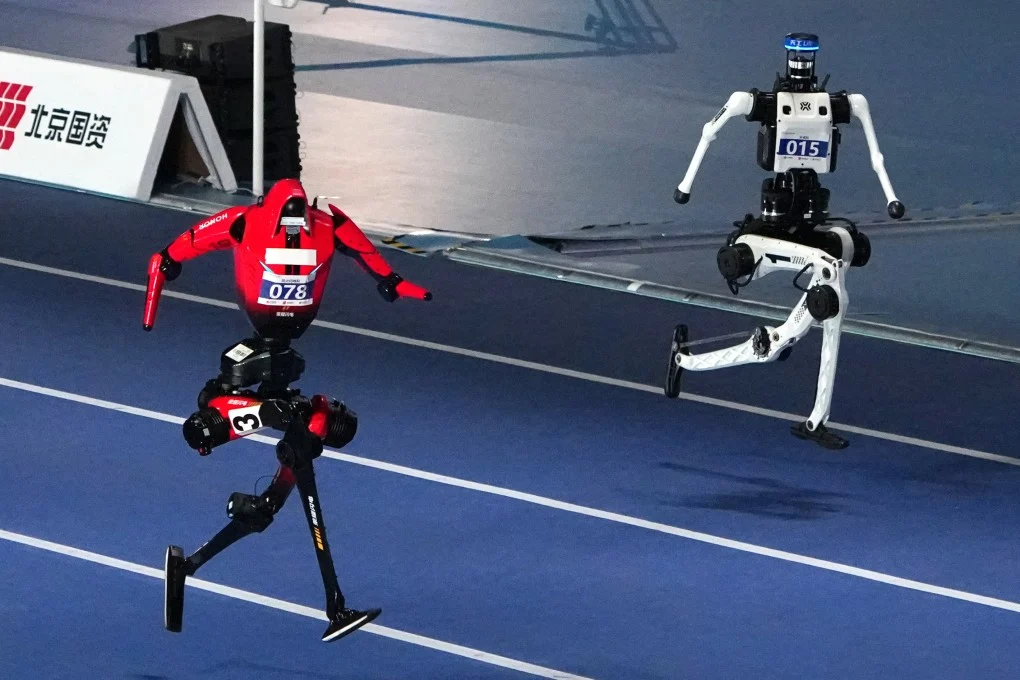
Jakarta, ThedailyID — China’s humanoid robots have shown they can outperform humans in speed, but simple real-world tasks remain a different challenge.
At the World Humanoid Robot Games in Beijing on Saturday (Aug. 22), two robots completed the 100-meter race faster than Usain Bolt’s world record of 9.58 seconds. The fastest robots also improved significantly from the 2025 event, when the winning time exceeded 20 seconds.


However, the robots still struggled to stop after crossing the finish line. Several crashed into thick mats placed a few meters beyond the finish.
The gap between physical performance and practical ability became even clearer in other competitions. Robots faced tasks that simulated work in factories, restaurants, offices and emergency situations.
More than 40% of the competitions required robots to operate fully autonomously, according to Huawei, a technology partner of the event.
Simple tasks such as connecting a cable proved particularly difficult. Robots had to identify the object, position their hands and bodies accurately, control the amount of force and correct mistakes without human assistance.
A slightly misplaced cable or an object outside the expected position could quickly expose the limitations of the machines.
“Only when robots can work in those end-use scenarios will they have real value,” Lumos Robotics CEO Yu Chao said.
“Simply running and jumping does not improve efficiency,” he added.
The five-day competition features 51 events, including 30 sports competitions and 21 work-based scenarios. Robots will also compete in tug-of-war, weightlifting, Tai Chi, traditional Chinese pitch-pot and autonomous tennis.
For the robotics industry, the real test may begin after the demonstrations end: whether these machines can reliably solve everyday problems once they leave the competition arena.