

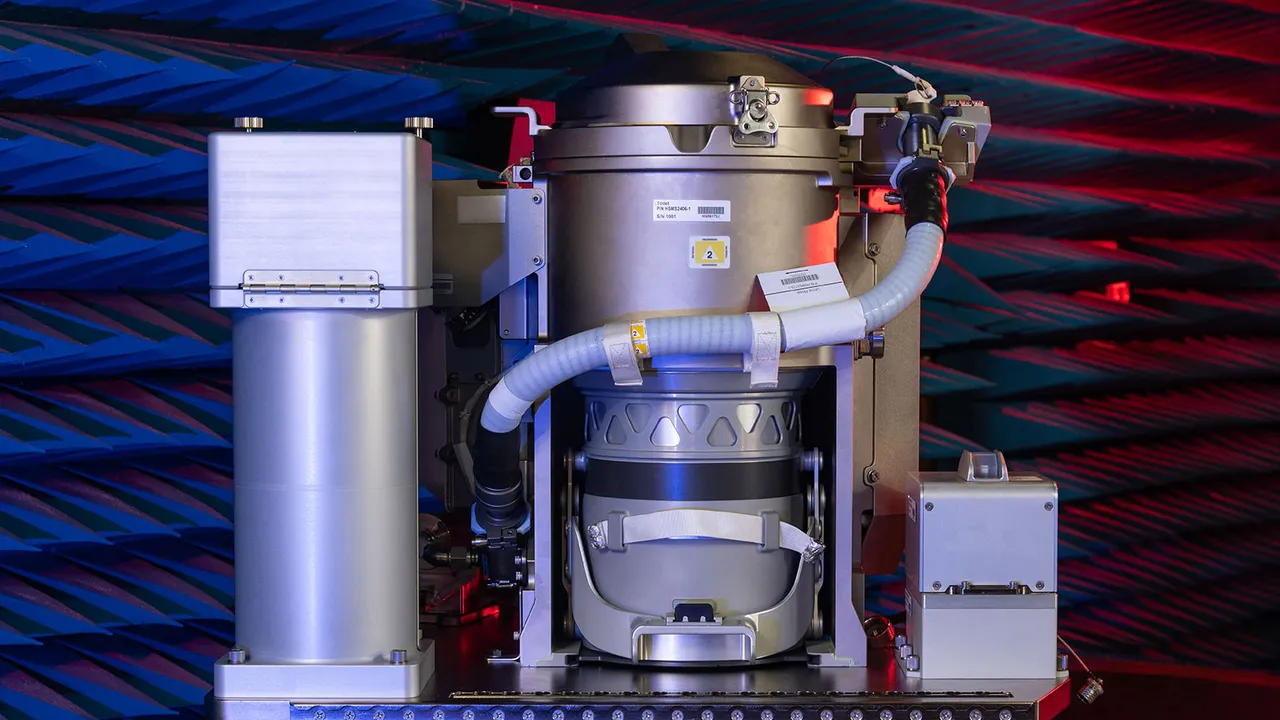
Jakarta, ThedailyID — NASA has invested US$23 million to develop two advanced space toilets that recycle astronauts’ urine into safe drinking water for long-duration missions.
The budget covers two units. NASA installed one aboard the International Space Station (ISS) and assigned the other to the Orion spacecraft for the Artemis II mission. The technology builds on nearly four decades of research into closed-loop water recycling.


NASA installed the Universal Waste Management System (UWMS) on the ISS in 2020 using Northrop Grumman’s Cygnus cargo spacecraft.
The toilet weighs about 45 kilograms and uses titanium components to resist corrosion from urine and acidic treatment chemicals. Engineers also redesigned the urine collection funnel to improve comfort for female astronauts.
Microgravity prevents liquids from flowing normally. To solve that problem, the system uses high-speed airflow to pull urine into the Urine Processor Assembly.
A centrifuge then creates artificial gravity. The system heats the liquid under partial vacuum, allowing water to evaporate at a lower temperature. It condenses the vapor before sending it through several filtration and catalytic treatment stages.
Finally, the system adds iodine to eliminate microbes and produce safe drinking water.
NASA says the technology recovers about 98% of the water collected from urine, sweat, and moisture in astronauts’ breath. The remaining concentrated waste, known as brine, still requires disposal.
The agency began researching closed-loop water recycling during the 1970s. At the time, astronauts aboard Skylab relied entirely on water delivered from Earth.
Engineers tested several approaches during the 1980s and 1990s, but many prototypes failed. NASA later adopted centrifuge-based technology and introduced the first operational water recovery system on the ISS in 2008.
The system experienced technical problems during its early years because the centrifuge motor consumed more electricity than expected. Engineers later improved the design and increased water recovery to 98% after adding a dedicated brine processor.
NASA also encountered issues with the Orion toilet during the Artemis II mission in April 2026. A faulty urine hose and a burning smell forced the crew to rely on emergency collection equipment for a period.
Despite the high cost, NASA says advanced recycling systems remain essential for future deep-space missions because transporting large amounts of water from Earth is not practical.