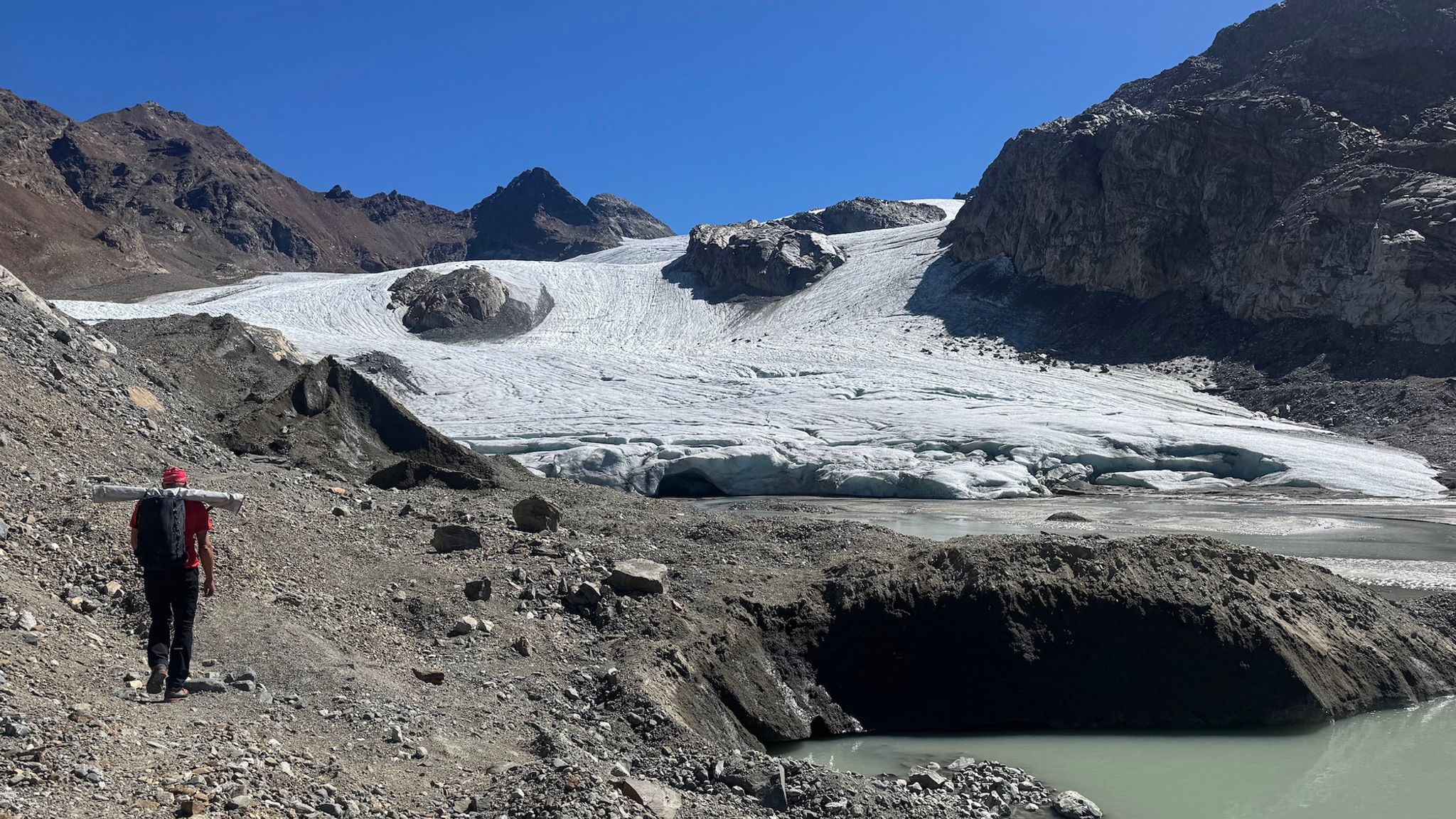
Jakarta, ThedailyID — Swiss glaciers have lost nearly one-fifth of their ice in just five years, as rising temperatures and reduced snowfall accelerate melting.
According to an annual monitoring report, Swiss glaciers shrank by 5.5% during the first eight months of 2026. Extreme summer heat and declining winter snowfall contributed to the loss.


The decline in 2026 is almost as large as the record loss recorded in 2022. Since 2021, Swiss glaciers have lost a total of 19.4% of their ice volume.
Matthias Huss, a glaciologist at ETH Zurich and lead researcher, said many people do not realize how quickly glaciers are disappearing.
“I visited one of them last week. It was striking to stand on this lunar-like landscape that had been covered by thick and extensive ice only a few years ago,” Huss said, as quoted by The Guardian on Monday, October 5.
The areas that once held thick layers of ice have now turned into rocky terrain. Some old chunks of ice remain scattered across the hot rocks and continue to melt.
Researchers have not yet released an official calculation of the total glacier loss for 2026. However, they said several small glaciers have already disappeared.
The research came from the Swiss Glacier Monitoring Network and the Swiss Commission for Cryosphere Observation. Researchers found that average glacier thickness fell by 2.5 to 4 meters this year.
The researchers also observed glaciers collapsing from within. Water flowing beneath the ice can create large cavities that weaken the glacier structure.
“There are huge holes in the middle of the ice where the roofs collapse, like a piece of cheese. This process damages the glacier and makes it shrink faster,” Huss said.
The Alps have experienced some of the most dramatic changes. Temperatures in Europe have risen about twice as fast as the global average, according to the source.
A study published by MeteoSwiss on September 29 found that the April-to-September period was the hottest and driest half-year since records began in 1864.
The researchers linked the broader warming trend to the accumulation of carbon dioxide in the atmosphere. The source said humanity has produced around 1.8 trillion tons of carbon dioxide emissions during that period, contributing to global warming of about 1.4 degrees Celsius.