
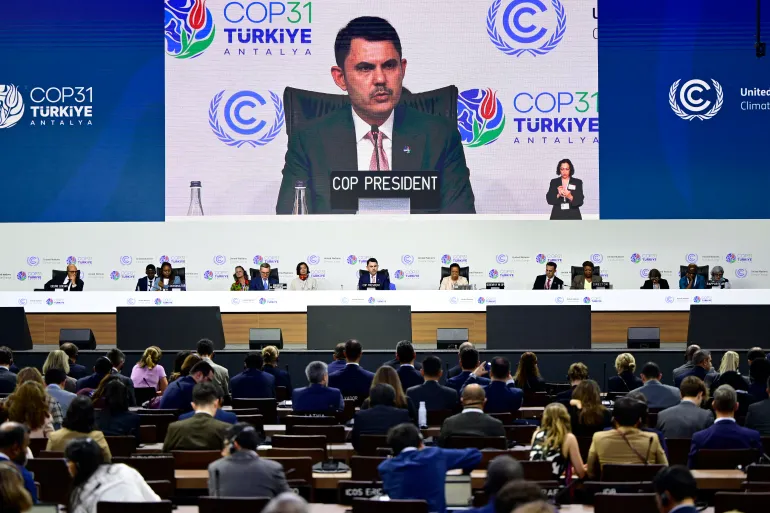
Jakarta, ThedailyID — Oil-producing countries are resisting efforts to include commitments to reduce fossil fuel use in the final agreement of the United Nations Climate Change Conference (COP31). The opposition has stalled climate negotiations under the leadership of Türkiye and Australia.
According to AFP, the COP31 presidency submitted its latest draft agreement on Sunday (November 22), after negotiations passed their deadline. However, the proposal once again avoided explicitly mentioning fossil fuels, including coal, oil, and gas.


The position has deepened tensions among nearly 200 participating countries. They must reach an agreement on the final COP31 document, but two weeks of negotiations have failed to bridge their differences over the future of fossil fuels.
The European Union and several other countries want a strong commitment to move away from fossil fuels. However, oil-rich nations, particularly Saudi Arabia, have rejected those demands.
An EU official told AFP that the latest proposal represented a step backward. The official also warned that COP31 could end without an agreement.
“I am more pessimistic today than yesterday,” the official said, requesting anonymity.
A German official also acknowledged the difficult negotiations due to resistance from oil-producing countries.
“The situation is difficult, and the outcome is uncertain. Oil-producing countries are putting up fierce resistance,” the official said.
Saudi Arabian officials declined to comment.
Fossil fuels remain one of the most sensitive issues in COP31 negotiations. The dispute comes amid rising energy prices and geopolitical tensions linked to the war in Iran.
An earlier draft released at the beginning of the week called for faster reductions in fossil fuel use. However, a shorter second draft on Thursday (November 19) removed all references to coal, oil, and gas.
Threats by several countries to leave the negotiations prompted Türkiye and Australia to arrange an emergency meeting between the EU and Saudi Arabia. The meeting aimed to find common ground.
The latest draft refers to the 2023 global agreement on transitioning away from fossil fuels. However, it still avoids explicitly naming fossil fuels.
The document also retains a controversial push to expand carbon capture and storage (CCS) technology. The fossil fuel industry supports the technology, but critics consider it expensive and ineffective at reducing emissions.
Antigua and Barbuda’s Environment Minister, Michael Joseph, also expressed disappointment with the draft.
“We are very disappointed with the appearance of this text,” Joseph said after leaving the COP31 presidency’s office.
“I cannot honestly say that I agree with this being adopted” in its current form, he added. Joseph also said the draft remained “quite silent” on fossil fuels.
Amid the deadlock, Türkiye and Australia have shifted attention toward electrification. They see it as a way to reduce greenhouse gas emissions while strengthening energy security.
The latest draft calls for electricity to account for 35 percent of global final energy consumption by 2035. It also encourages wider adoption of clean energy.
Electrification replaces technologies that directly burn fossil fuels, such as diesel cars and gas-powered heating systems, with electric alternatives.
However, several countries want targets that explicitly mention clean energy. They fear electrification could remain dependent on fossil fuels if electricity does not come from renewable sources.
Around one-third of global electricity production currently relies on coal. Fossil gas accounts for roughly another fifth.
COP31 has faced pressure to demonstrate progress in tackling rising greenhouse gas emissions. The negotiations are taking place amid climate-related disasters across several regions, including Europe, Nepal, and Indonesia.
Beyond the fossil fuel dispute, another disagreement concerns efforts by Saudi Arabia, India, and Kenya to delay the next report from the UN’s Intergovernmental Panel on Climate Change (IPCC).
The latest draft only stresses the report’s importance for the 2028 global assessment of efforts to reduce emissions.
Dozens of countries across Europe, Africa, and the Pacific want the global climate science authority to publish its findings on schedule, before that assessment takes place.
COP31 participants also remain divided over how to address the risk of global warming exceeding the 1.5-degree Celsius limit set by the Paris Agreement.
In the latest draft, countries express “deep concern” that global temperatures will exceed 1.5 degrees Celsius above pre-industrial levels in the coming years.
Negotiations have also stalled over a longstanding dispute about wealthy countries’ responsibility to help developing nations address climate change impacts.
The removal of a US$120 billion climate adaptation funding target from the latest draft has also angered developing countries.