

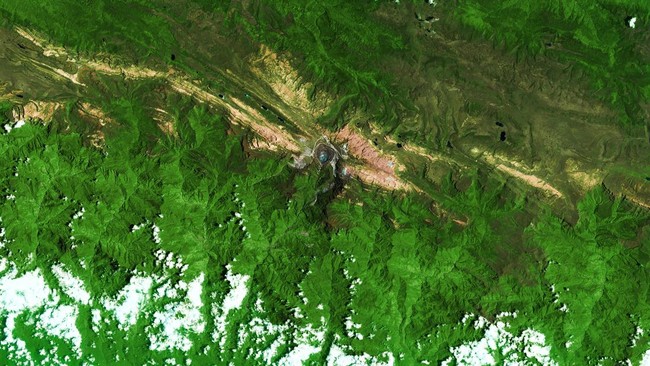
Jakarta, ThedailyID — NASA has revealed that the remaining perennial ice on Puncak Jaya in Papua has shrunk dramatically. Scientists say it no longer qualifies as an active glacier and could disappear entirely in the coming years.
“Near the summit of Puncak Jaya, the ice has shrunk into patches that are too small to flow like a glacier,” NASA said on its official website on Monday, November 16, 2026.
A glacier is a large, thick mass of ice that forms on land. It develops as accumulated snow hardens and recrystallizes over centuries. Unlike ordinary ice deposits, glaciers can flow under their own weight and hold the largest reserves of freshwater on Earth.


Puncak Jaya’s ice sits in the Sudirman Mountains, near the Indo-Pacific Warm Pool, the largest expanse of warm ocean water on Earth. The ice once survived throughout the year.
However, its condition now resembles other rapidly disappearing ice formations. These include the remnants of Venezuela’s Humboldt Glacier, Peru’s Quelccaya Ice Cap, and Tanzania’s Kilimanjaro ice fields.
NASA Earth Observatory images show the dramatic changes through satellite comparisons. The images include observations from Landsat 5 in 1988 and Landsat 9 in 2026.
According to climate scientist Donaldi Permana of Indonesia’s Meteorology, Climatology, and Geophysical Agency (BMKG), the glacier covered approximately 4.31 square kilometers in 1988.
However, satellite and aerial data showed that only around 0.09 square kilometers remained by September 2025. This represents roughly 2 percent of its 1988 area.
Measurements at the East Northwall Firn monitoring site also show a sharp decline. Ice thickness fell from 32 meters in 2010 to around four meters in 2023. By November 2024, the ice at that location had disappeared completely.
As ice layers become thinner, glaciers crack and break into smaller fragments. Each new fragment exposes more surface area to warm air and sunlight, accelerating the melting process.
NASA’s 2026 Landsat images also show more exposed bedrock between the remaining ice fragments. Although snow still falls in the area, it lands on exposed rock that absorbs heat. As a result, the snow melts before it can accumulate and compact into new glacier ice.
“Once this process starts, when the ice breaks apart, there is really no way back,” said Chris Shuman, a retired glaciologist from the University of Maryland who has tracked Puncak Jaya’s glacier through satellite imagery.
For an ice mass to qualify as a glacier, it generally needs enough thickness to flow downhill under its own weight. It also needs an area where snowfall accumulates faster than the ice melts.
The remaining ice on Puncak Jaya has become too thin and fragmented to flow.
“Although small remnants of ice still survive in high-altitude depressions around Puncak Jaya, their functional role as an active glacier has essentially ended,” Permana said.
However, the remaining ice faces an even greater threat. Recent satellite studies suggest that the main glacier area could disappear completely around 2030.
Permana said BMKG projections indicate that a very strong El Niño could accelerate the process and cause the ice to disappear even sooner.
As temperatures rise, conditions at the mountain summit become too warm for atmospheric moisture to freeze. Consequently, precipitation falls as rain instead of snow.
This deprives the glacier of fresh white snow, which normally reflects sunlight. Rainwater, meanwhile, accelerates the melting of the remaining ice.
During the 2015–2016 El Niño, the ice thinned around five times faster than usual. The estimated annual loss reached approximately 5.3 meters in thickness.
The 2023–2024 El Niño also triggered another period of rapid thinning. During that period, the ice lost around two to four meters in thickness annually.