
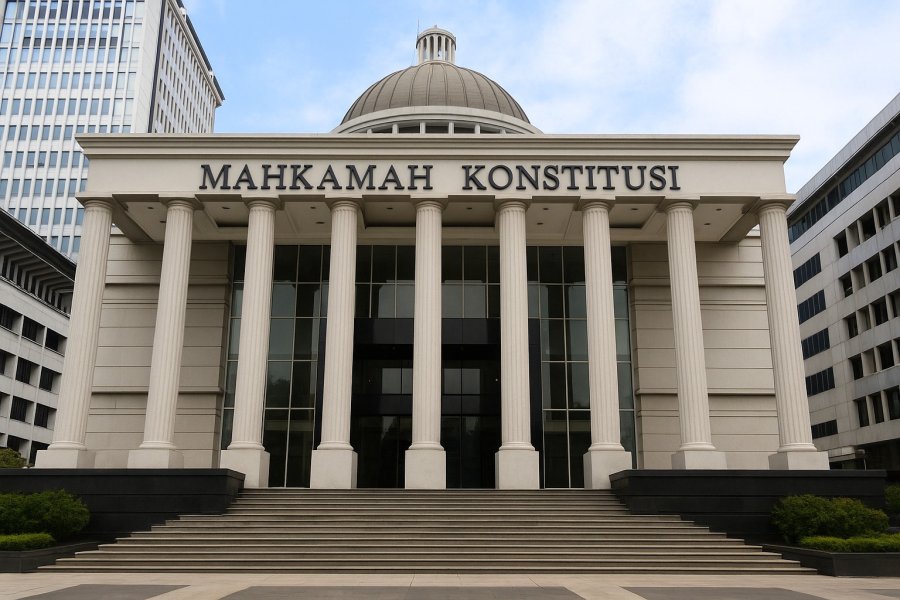
Jakarta, ThedailyID — Indonesia’s Constitutional Court has rejected a lawsuit filed by four residents of Palangka Raya, Central Kalimantan, over the adequacy of disaster management funding, including budgets for forest and land fires.
The court issued its ruling on Thursday, October 29 under Case No. 369/PUU-XXIV/2026.

In its decision, the court said insufficient disaster funding in a particular budget year does not automatically make the Disaster Management Law unconstitutional. Judge Liliek Prisbawono explained that unexpected emergencies could require spending beyond the initial allocation.
The court also ruled that the phrase “adequate” in the law does not violate Article 23(1) of Indonesia’s 1945 Constitution, which requires transparent and accountable state budget management.
According to the court, Indonesia already has mechanisms to oversee public spending. These include budget discussions with the House of Representatives (DPR), audits by the Supreme Audit Agency (BPK), and reports on budget realization.
The judges said authorities must assess disaster funding by comparing planning documents, disaster risks, budget allocations, and actual spending.
The court acknowledged the residents’ concerns about forest and land fires in Central Kalimantan, particularly in peatland areas. However, it said the fiscal burden of disaster response relates to budget transfers, spending priorities, and coordination between central and regional governments.
The court considered these issues matters of policy implementation, not evidence that the law violates the Constitution.
“Therefore, the applicants’ arguments lack a legal basis and must be declared legally unfounded,” Liliek said while reading the ruling.
The residents challenged the phrase “adequate” in Article 6(e) and Article 8(d) of Law No. 24 of 2007 on Disaster Management. These provisions require the central and regional governments to allocate disaster management funding through the state budget (APBN) and regional budgets (APBD).
The applicants argued that the law provides no objective standard for determining whether disaster funding meets the needs of areas facing different levels of risk.
They also highlighted the high risk of forest and land fires in Central Kalimantan’s peatlands, arguing that these areas could face an uneven fiscal burden during disaster response.
The residents asked the court to require adequate funding for all disaster management stages, including prevention, emergency response, and post-disaster recovery. They also sought transparent and accountable budget allocation.