
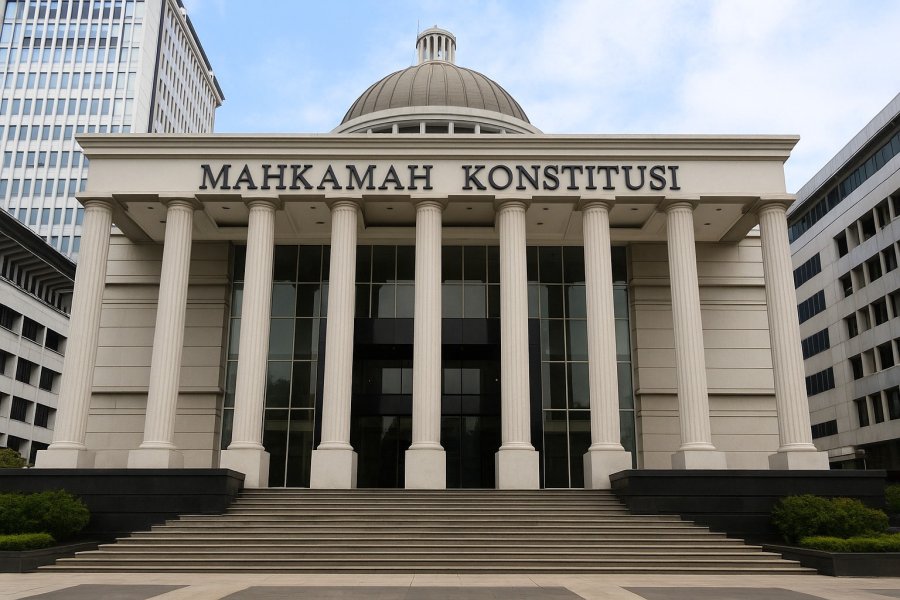
Jakarta, ThedailyID — An Indonesian woman has challenged tax regulations affecting menstrual pads at the Constitutional Court (MK), arguing that menstrual hygiene needs deserve consideration in the country’s tax policy.
Bernita Matondang filed the petition under case number 406/PUU-XXIV/2026. During the second hearing on Monday, November 23, she revised the provision under review.


Initially, she challenged Article 16B paragraph (1a) letter j point 1 of Law No. 7 of 2021 on the Harmonization of Tax Regulations. However, she later narrowed the challenge to its explanatory section.
The hearing was presided over by Constitutional Court Justice Enny Nurbaningsih, alongside Justices Ridwan Mansyur and Arsul Sani.
“I ask the Court to pay attention to this case, because behind the figure of Rp2,000 per package lies the dignity of women waiting to be recognized,” Bernita said, according to her petition published on the Court’s official website.
Bernita argued that the explanation of Article 16B paragraph (1a) letter j point 1 contradicts the 1945 Constitution. She said the constitutional issue goes beyond the fact that menstrual pads do not appear explicitly in the provision.
Instead, she questioned whether the government has guaranteed objective, rational, and proportionate criteria for determining which essential goods qualify for tax treatment. Those criteria, she argued, should also consider menstrual hygiene needs arising from women’s biological processes.
According to Bernita, the absence of such guarantees could prevent essential needs related to human biological functions from receiving equal consideration in tax policy.
“This creates a problem of fair legal certainty, as guaranteed under Article 28D paragraph (1) of the 1945 Constitution,” she said.
Bernita clarified that the absence of menstrual pads from the provision does not automatically make it unconstitutional. Rather, she questioned the criteria used to determine which essential goods qualify for VAT treatment.
In her petition, she asked the Court to declare the explanation of Article 16B paragraph (1a) letter j point 1 unconstitutional and legally nonbinding unless interpreted more broadly.
Under her proposed interpretation, essential goods needed by the public should not be limited to the categories listed in letters a through k. The provision should also cover menstrual hygiene products and other needs related to biological functions.