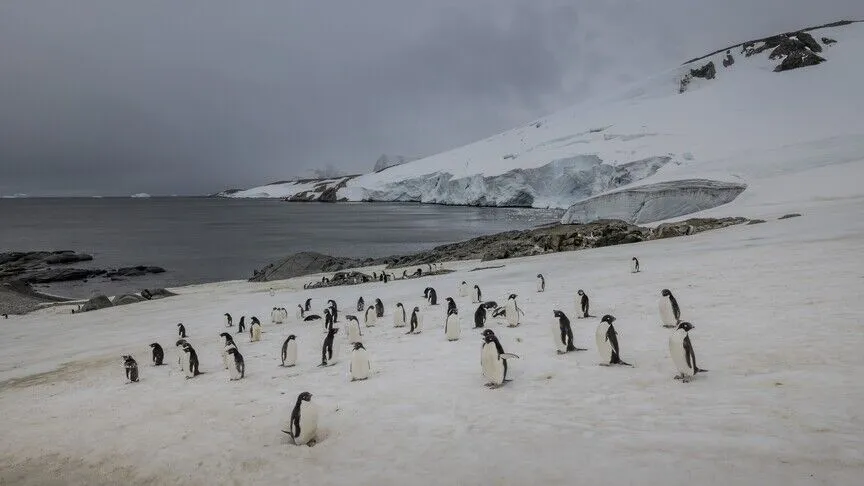
Jakarta, ThedailyID — The chinstrap penguin population on Zavodovski Island has fallen by around two-thirds since 2011. Scientists suspect climate change is the main driver behind the decline.
A study published in Current Biology on October 7, 2026, found that the population has dropped rapidly. Researchers warn that the decline could threaten the wider Antarctic ecosystem.


“This is a huge population decline, equivalent to the loss of half a million breeding individuals from the island,” said lead researcher Norman Ratcliffe, a penguin ecologist at the British Antarctic Survey, as quoted by The Guardian on Friday, October 9.
Zavodovski Island lies in the northern part of the South Sandwich Islands near Antarctica. A 2011 count recorded around 600,000 chinstrap penguins and 90,000 macaroni penguins there.
By 2025, the chinstrap population had fallen so sharply that Zavodovski may no longer hold the title of the world’s largest penguin colony. Cape Adare in the Ross Sea could now take that position.
Chinstrap penguins have a distinctive black line beneath their beaks that resembles a chinstrap. The latest findings suggest their population decline may be accelerating, raising concerns about their conservation status.
Scientists previously reported declining chinstrap numbers on Low Island in the South Shetland Islands in 2020. Those findings had already raised concerns about disruption to Antarctic ecosystems.
This time, researchers identified climate change as the most likely explanation for the decline on Zavodovski Island.
Human-driven warming has raised winter temperatures in and around the Antarctic Peninsula by as much as 5 degrees Celsius above preindustrial levels.
On June 6, 2026, Argentina’s Esperanza Base on the Trinity Peninsula recorded a winter temperature of 15.4 degrees Celsius. That was around 20 degrees Celsius above the normal temperature for that period.
Chinstrap penguins struggle to adapt because they depend on specific food sources and ocean temperatures. Tracking data shows they prefer feeding in cold waters northwest of Zavodovski Island.
There, they hunt Antarctic krill, which makes up most of their diet. However, as the waters warm, krill populations are shifting south toward the Weddell Sea.
Macaroni penguins, by contrast, have a more varied diet. Their population increased by 30 percent, but that growth has not offset the loss of chinstrap penguins.
Ratcliffe said the increase in macaroni penguins offers little comfort. If current trends continue, he warned, all penguins could eventually run out of space.
The loss of chinstrap penguins could also affect the wider food web. “Every ecosystem is like a giant Jenga tower, and removing each component increases the risk of the entire ecosystem collapsing,” Ratcliffe explained.
Researchers also examined other possible causes. They found no evidence that chinstrap and macaroni penguins were competing for food, while the nearest human settlements lie thousands of kilometers away.
A major volcanic eruption on Zavodovski in 2016 had raised another possibility. Some researchers considered a sudden population collapse, dubbed “Penguin Pompeii,” as a potential consequence.
However, the data did not support that theory. Instead, the decline appeared gradual and consistent over time.
Field observations also showed that chinstrap penguins avoided the main area known as the asphyxia plain, where volcanic ash and lava had accumulated.
The findings highlight growing concerns about how climate change can disrupt wildlife populations and the ecosystems that depend on them.