
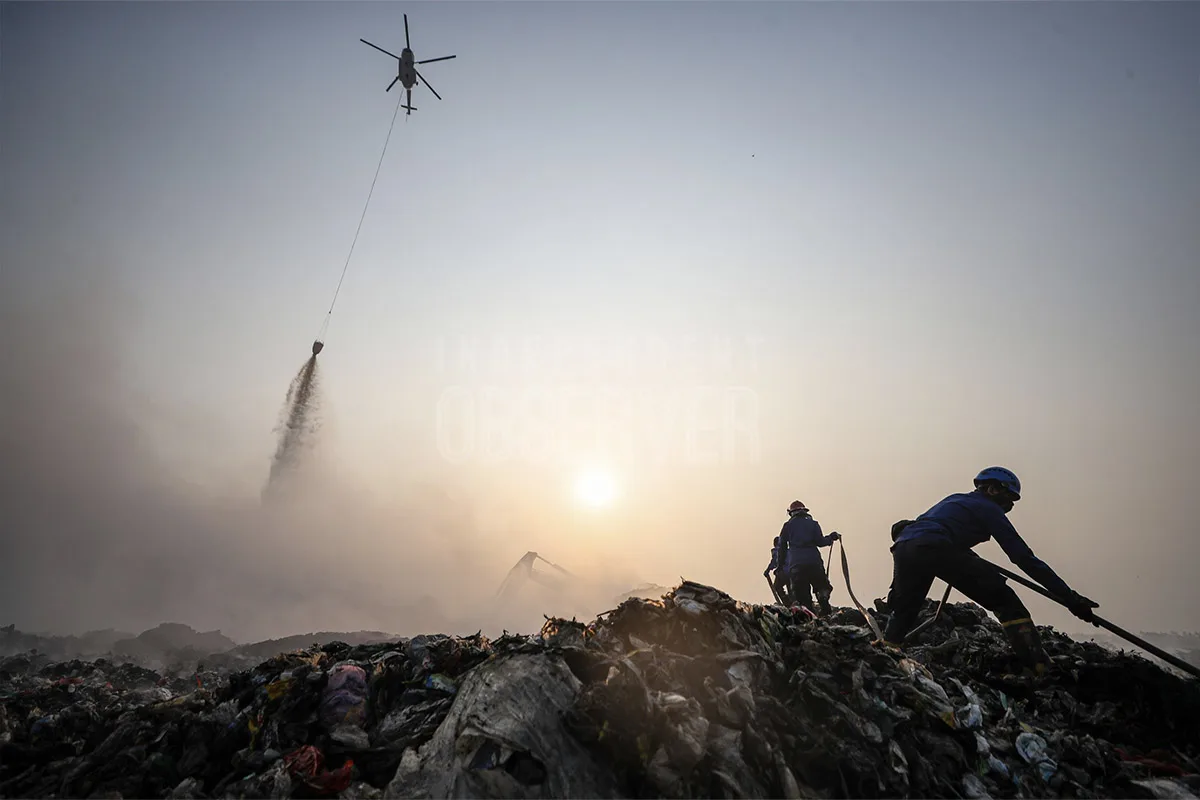
Jakarta, ThedailyID — The fire at Jatiwaringin Landfill in Mauk, Tangerang Regency, has burned since June 30. Firefighters are still working to extinguish the remaining hotspots nearly a week later.
As of Sunday, about 3.6% of the affected area, or 1.68 hectares, remained on fire. The blaze had previously spread across 18 hectares.
The Tangerang Regency Regional Disaster Management Agency (BPBD) believes extreme heat contributed to the fire.
BPBD chief Achmad Taufik said years of accumulated waste produced methane gas. Extreme temperatures likely ignited the gas.
“The landfill has stored methane gas for years. When temperatures become extremely high, the gas can ignite,” Taufik said.
Similar landfill fires have occurred during Indonesia’s dry season. In 2023, major fires hit the Sarimukti Landfill in West Bandung, Putri Cempo Landfill in Solo, and Jatibarang Landfill in Semarang.
At the time, authorities linked the incidents to prolonged dry weather and the El Niño climate pattern.
However, waste management expert Dini Trisyanti, director of Sustainable Waste Indonesia, said weather alone does not explain the latest fire.
She argued that poor landfill operations likely played a much bigger role.
“I agree that weather is a factor. However, I also believe the landfill was not operated properly according to regulations,” she said.
Hot weather increases fire risks because organic waste naturally produces methane, a highly flammable gas. Meanwhile, dry conditions also make it harder for firefighters to access enough water.
Even so, Dini stressed that operational failures allowed the fire to spread more rapidly.
She noted that Indonesia experiences a dry season every year. Yet landfill fires continue to occur repeatedly.
Dini suspects some landfill operators still rely on open dumping. Under that system, operators leave waste uncovered instead of sealing it with layers of soil.
She said the practice may violate Article 44 of Law No. 18 of 2008 on Waste Management. The law requires local governments to phase out open dumping systems.
According to Dini, covering waste with soil reduces fire risks. The protective layer limits methane exposure and slows the spread of flames.
She compared a properly managed landfill to a layered cake. Workers add a layer of soil each time they dump new waste.
Source: CNN Indonesia