

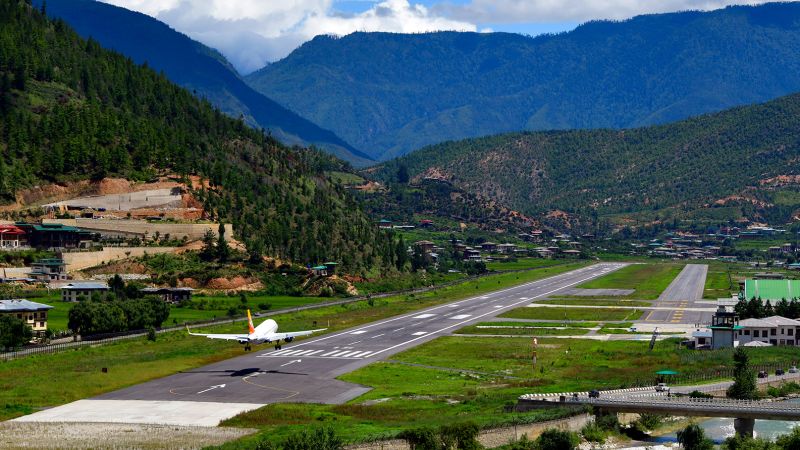
Jakarta, ThedailyID — Landing is often the most stressful part of a flight. At Paro International Airport in Bhutan, it becomes an even greater challenge.
The airport sits inside a narrow Himalayan valley. As a result, pilots must navigate steep mountains before reaching the runway. Many aviation experts consider Paro one of the world’s most difficult airports.


Only specially trained pilots can fly there. Airlines require them to complete route-specific training before receiving certification. They must also master the surrounding terrain and weather conditions.
Captain Chimi Dorji, a senior pilot at Druk Air, says Paro is difficult but not dangerous.
“It is challenging for pilots, but not dangerous. If it were dangerous, I would not fly here,” Dorji told CNN Travel.
Pilots cannot depend on modern radar during the approach. Instead, they fly manually and use visual landmarks to guide the aircraft. Therefore, they must memorize nearby mountains, valleys, villages, and ridgelines.
Even a small navigation mistake can have serious consequences. A slight deviation could bring an aircraft dangerously close to homes or mountain slopes.
Bhutan’s landscape makes every landing more demanding. More than 97% of the country is mountainous. Meanwhile, the capital, Thimphu, sits about 2,350 meters above sea level. At that altitude, thinner air reduces aircraft performance. Consequently, pilots must maintain higher approach speeds.
Weather creates another challenge. Airlines schedule most arrivals during the morning because conditions remain calmer. By afternoon, thermal winds become much stronger. In addition, turbulence increases as temperatures rise.
Authorities also ban night operations at Paro. The airport lacks radar systems needed for nighttime approaches. During the monsoon season, heavy rain, thunderstorms, and hail make operations even more difficult.
Despite these obstacles, Bhutan continues to train more local pilots. Druk Air runs much of the country’s flight training program. Trainees must prove they can operate safely throughout the year and in every weather condition.
Paro International Airport remains one of aviation’s toughest destinations. Nevertheless, experienced pilots safely complete landings there every day through precision, preparation, and extensive local knowledge.