

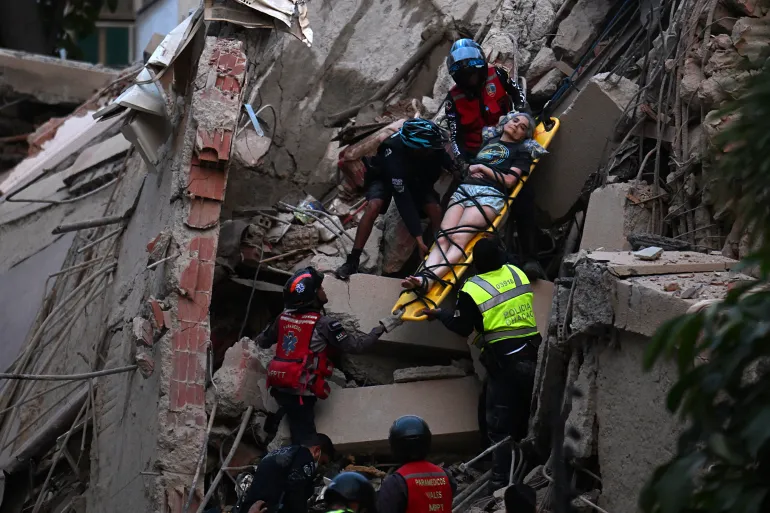
Jakarta, ThedailyID — Venezuela’s twin earthquakes have killed at least 32 people and injured more than 700, while the U.S. Geological Survey (USGS) warned the final death toll could rise sharply because of vulnerable buildings across the affected region.
According to USGS, the back-to-back earthquakes measured magnitude 7.2 and 7.5. The agency said the two tremors struck just 39 seconds apart on Wednesday afternoon local time.


The first earthquake struck at a depth of 22 kilometers. USGS located its epicenter about 21 kilometers west of the coastal city of Morón, roughly 160 kilometers west of Caracas.
Thirty-nine seconds later, the second earthquake struck at a depth of 10 kilometers. According to USGS, the epicenter lay about 45 kilometers from the first quake.
Interim President Delcy Rodríguez said at an early Thursday press conference that at least 32 people had died and more than 700 others had suffered injuries.
However, USGS warned that rescue teams could uncover far more casualties in the coming days.
“High casualties and extensive damage are probable, and the disaster is likely widespread,” the agency said in its preliminary assessment.
According to USGS, many residents live in buildings that cannot withstand strong earthquakes. The agency identified unreinforced brick structures and adobe block buildings as the most vulnerable.
USGS estimates a 42% probability that the final death toll could reach between 10,000 and 100,000 people. It also estimates a 33% probability that fatalities could total between 1,000 and 10,000.
The agency said emergency planners use those figures for disaster response planning. They do not represent confirmed casualties.
According to USGS, the earthquakes originated in Yaracuy state, west of Caracas. Authorities identified Altamira and El Paraíso as the hardest-hit neighborhoods in the capital. Officials also reported significant damage in La Guaira and several parts of central Venezuela.
Meanwhile, CNN cited MHP Structural Engineers’ Kenneth O’Dell, who said many buildings across Venezuela predate modern seismic standards.
According to O’Dell, developers built many of those structures before the early 1970s. As a result, they face a greater risk of collapse during powerful earthquakes.