

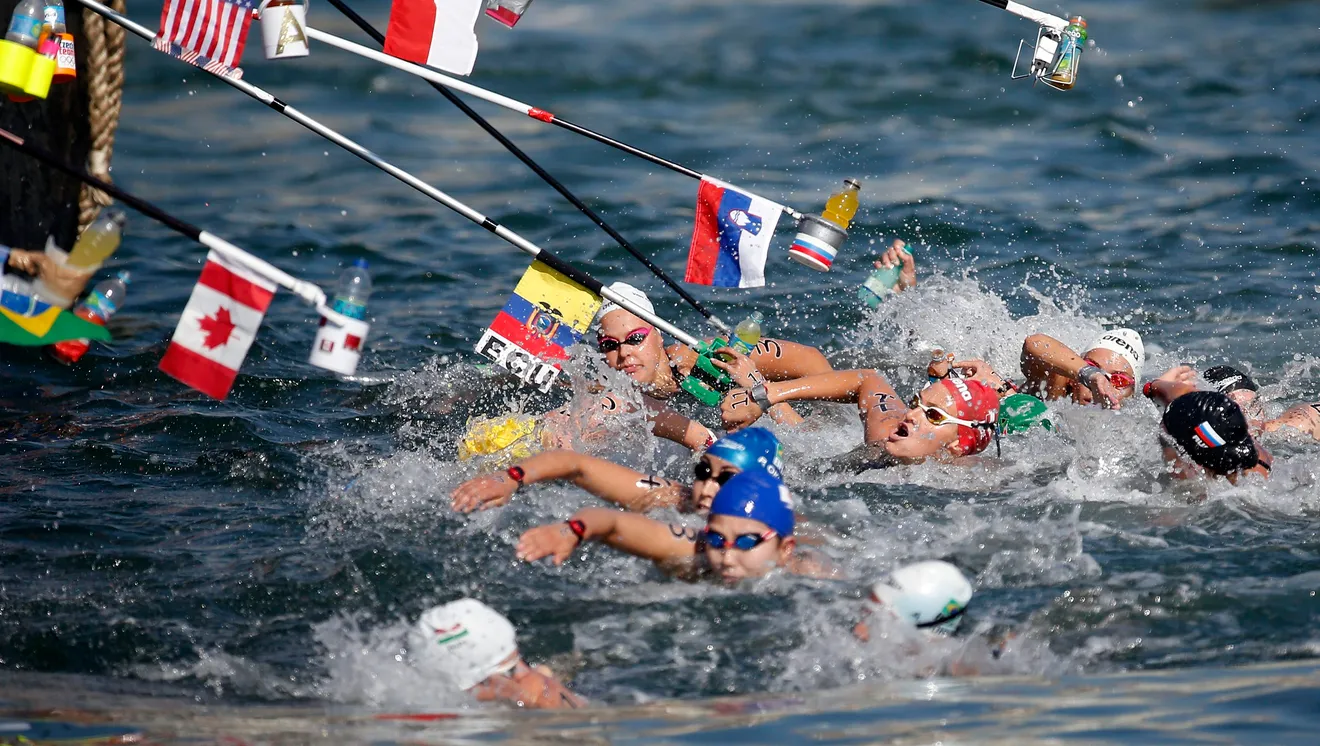
Jakarta, ThedailyID — Endurance sports are not limited to running dozens of kilometers on land. Swimmers can also test their limits by crossing open water, including seas, lakes, rivers, and straits.
This discipline is known as marathon swimming. Unlike pool swimming, which uses marked lanes and walls, participants follow designated routes through natural bodies of water.

According to the World Open Water Swimming Association (WOWSA), marathon swimming involves long-distance swimming in open water over a minimum distance of 10 kilometers.
The sport takes place in various environments, including seas, oceans, lakes, rivers, and canals.
People often confuse marathon swimming with open water swimming. However, the two terms have different meanings.
World Aquatics defines open water swimming as competitive swimming in natural bodies of water over varying distances.
Marathon swimming falls under the broader open water swimming category. However, it requires participants to cover at least 10 kilometers.
Therefore, not every open water swimming competition qualifies as marathon swimming.
How Does Marathon Swimming Work?
Participants must follow a route set by the event organizer. Competitions generally follow several rules and procedures.
1. Swimmers Follow a Designated Route
Organizers usually place floating markers, known as buoys, along the course. These markers guide swimmers and help them stay on the correct route.
Courses may follow a circular layout or run from one starting point to another destination.
2. Distances Can Reach Dozens of Kilometers
Open water swimming competitions offer different distances, including 5 kilometers and 10 kilometers.
However, some community-organized marathon swimming events offer challenges beyond 10 kilometers. Certain routes can even extend for dozens of kilometers.
3. Safety Remains a Top Priority
Open water swimming presents greater challenges than swimming in a pool. Currents, waves, water temperatures, and visibility can change throughout a race.
Organizers generally deploy safety officers, rescue boats, kayaks, and medical teams along the course.
In some individual long-distance categories, swimmers can also receive food and drinks from support crews aboard accompanying boats.
4. The Fastest Swimmer Wins
In competitive events, the swimmer who completes the designated course in the shortest time wins.
Participants must also cross the finish point according to the organizer’s rules.
However, not every marathon swimming event involves mass competition. Some individual challenges focus on completing a specific distance.
Organizations may then record or certify the swimmer’s achievement.
Where Is Marathon Swimming Held?
Open water swimming has grown across many countries. Events range from World Aquatics international competitions to regional championships and community-organized long-distance challenges.
In 2026, World Aquatics held its Open Water Swimming World Cup series at several locations, including:
1. Egypt
Somabay hosted one of the 2026 World Aquatics Open Water Swimming World Cup events. The coastal destination sits along the Red Sea, providing an open-water competition venue.
2. Spain
Ibiza hosted an open water swimming competition in the Mediterranean Sea. The island is known for its coastal waters and various water sports activities.
3. Italy
Golfo Aranci in Sardinia also featured on the international competition calendar. The destination lies along the Mediterranean coast.
4. Portugal
Setúbal hosted a competition along the Atlantic Ocean. The region is also known as a venue for international open water swimming events.
Beyond World Aquatics competitions, WOWSA lists several destinations known for long-distance swimming challenges.
These include:
- United Kingdom: English Channel.
- Japan: Tsugaru Strait.
- Australia: Derwent River.
- United States: Catalina Channel.
- New Zealand: Lake Taupo.
- Malaysia: Kapas Marang Swimathon and Perhentian Island Challenge.
- Denmark and Sweden: Øresund Strait.
Each location presents different challenges. Some involve crossing straits with strong currents and cold water, while others take place in lakes or coastal areas.
However, these destinations do not all host official World Aquatics competitions. Some feature individual swimming challenges or events organized by local communities and organizations, with varying distances.
Being able to swim in a pool does not automatically prepare someone for a 10-kilometer marathon swimming challenge.
The sport requires specific preparation because participants must swim for extended periods without stopping at a pool wall to rest.