

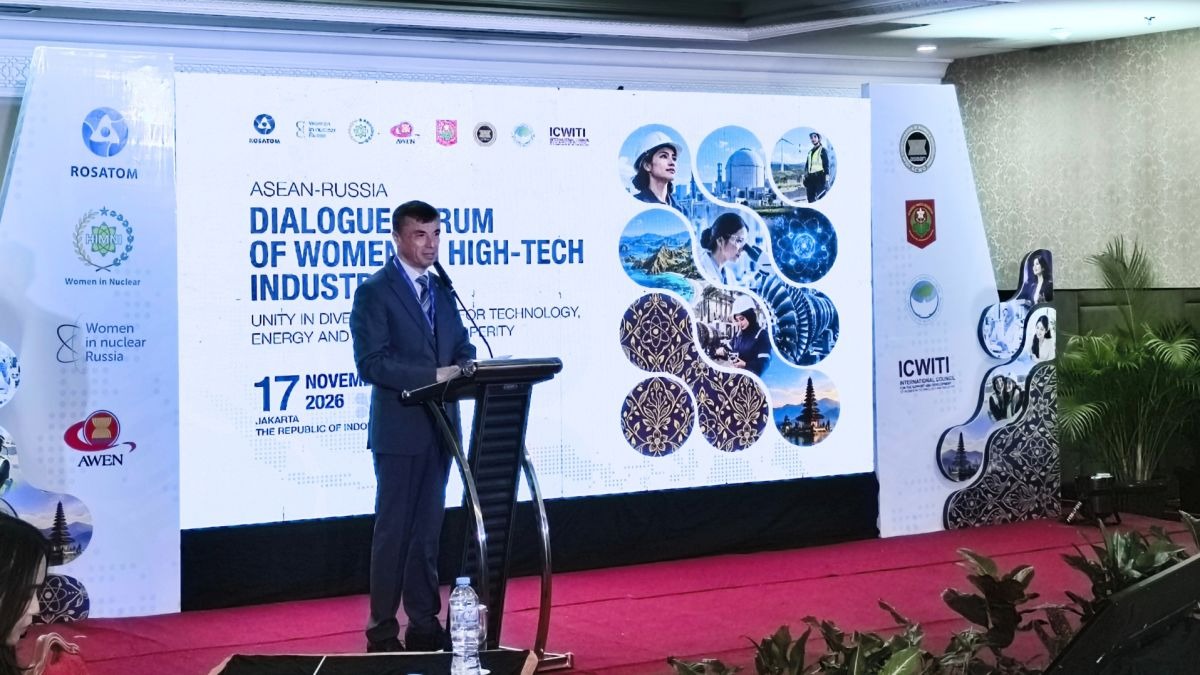
Jakarta, ThedailyID — Russia and ASEAN countries have agreed to strengthen women’s participation in technology and high-tech industries through new cooperation initiatives. The agreements emerged from the ASEAN–Russia Dialogue Forum of Women in High-Tech Industries, held in Jakarta on November 17, 2026.
The forum brought together women representatives from Russia, Indonesia, the Philippines, Cambodia, Myanmar, Laos, Singapore, Vietnam, and Malaysia. For the first time, organizers held the event in a Russia–ASEAN format.


Participants identified several priorities for joint cooperation. These include nuclear technology, engineering education, digital transformation, and women’s entrepreneurship.
The discussions resulted in new cooperation agreements and the Jakarta Women in Technology Action Plan 2026.
The opening ceremony featured Sergey Tolchenov, Russia’s Ambassador to Indonesia; Stella Christie, Indonesia’s Vice Minister of Higher Education, Science and Technology; and Nita Yudi, Chairwoman of AWEN Indonesia and the BRICS Women’s Business Alliance in Indonesia. Representatives of leading Indonesian professional associations also attended.
Participants highlighted the role of women’s professional organizations in building international partnerships. Yenny Wahid, Chair of the Indonesian Women’s Congress (KOWANI) and Chair of the ASEAN Confederation of Women’s Organizations (ACWO) for 2027–2028, delivered the keynote address.
“Unity in diversity is not only Indonesia’s national motto, but also an important principle of international cooperation. By bringing together the experience and capabilities of women from our countries, we can create new opportunities for their professional development,” Yenny said.
She added that dialogue between women from Russia and ASEAN could establish long-term partnerships for future generations.
Another key topic involved cooperation between Russia and Indonesia in preparing specialists for Indonesia’s future nuclear industry.
Anna Belokoneva, Head of Rosatom State Corporation’s Regional Office in Indonesia, highlighted the country’s nuclear energy ambitions. Indonesia targets 7 GW of installed nuclear capacity by 2040 and 35 GW by 2060.
“Indonesia’s large-scale and ambitious nuclear energy development programme requires the development of a skilled national workforce for the country’s future nuclear industry,” Belokoneva said.
She noted that Indonesian students, including young women, already participate in Rosatom’s educational programmes. The company also involves them in initiatives and events that introduce career opportunities in the nuclear sector.
During thematic discussions, participants exchanged experiences in developing strategic industries, training STEM professionals, advancing digital transformation, and expanding international technology partnerships.
Alexandra Ryabykh, the forum’s co-organizer and Head of Rosatom Women’s Community, said the partnership with Indonesia had created a foundation for broader cooperation across Southeast Asia.
She also highlighted the Green Future International Women’s Environmental Projects Competition, which Rosatom is developing in BRICS countries and partner states.
“We see considerable potential for women from Southeast Asia to participate in our initiatives. The next practical step will be to implement the Jakarta Action Plan developed by the Forum participants,” Ryabykh said.
The programme also featured a Career Lab titled “From STEM Education to Decision-Making in Industry.” The session explored ways to encourage girls to pursue careers in science, engineering, and nuclear energy.
Professor Geni Rina Sunaryo, Head of the Women’s Empowerment Department of the Indonesian Nuclear Society (HIMNI), emphasized the importance of early STEM education and mentorship.
“Our shared responsibility is to provide them with access to knowledge, support and mentorship so they can confidently choose their career paths,” she said.
Sunaryo also highlighted educational initiatives under the International Council for Supporting and Developing Women in Industry and Technology. With support from Rosatom Women’s Community, the initiatives include “Girls in STEM” seminars for schoolgirls and female university students.
The forum also hosted a signing ceremony for memoranda of cooperation between Rosatom Women’s Community and professional and business associations from Indonesia and the Philippines.
The agreements cover joint educational and mentoring programmes, support for women in STEM, and the expansion of international professional networks.