

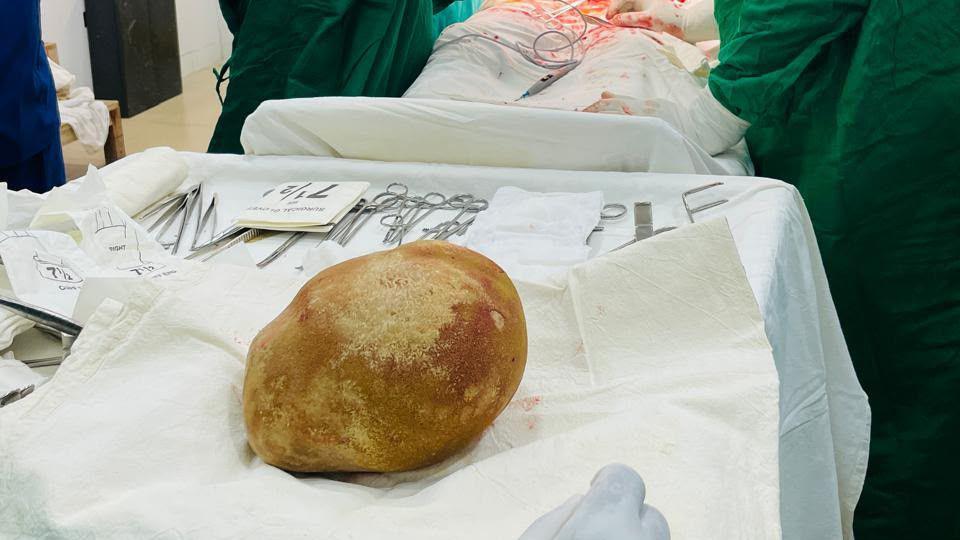
Jakarta, ThedailyID — Doctors in Sri Lanka removed an unusually large bladder stone from a 55-year-old man. The stone weighed 3.1 kilograms and measured around 17 centimeters long.
A specialist team led by urologist Pragaladhan Balakrishnan performed the operation at Trincomalee District General Hospital.


The stone was roughly the size of an ostrich egg. Its weight also came close to that of a newborn baby.
Doctors believe the stone could rank among the largest bladder stones ever removed through surgery and documented. However, the claim still requires official verification.
According to NDTV Life, Balakrishnan said available records indicate that the stone was the largest documented bladder stone removed through a surgical procedure.
The patient was reportedly in very good condition after the operation. He had previously received treatment at the hospital following a stroke.
During his treatment, doctors noticed that he had difficulty urinating. Further examinations then revealed the unusually large stone inside his bladder.
Bladder stones form when minerals in concentrated urine crystallize inside the bladder. Normally, the bladder empties completely during urination.
However, urine can remain in the bladder when it cannot empty properly. Over time, minerals can accumulate and form a stone.
Small bladder stones can sometimes pass through the urinary tract without treatment. Larger stones, however, can cause irritation, pain, and problems with urine flow.
Doctors generally classify bladder stones larger than 4 centimeters as giant stones. At around 17 centimeters, the stone found in Sri Lanka was therefore exceptionally large.
Several conditions can increase the risk of bladder stones. These include an enlarged prostate, urinary tract blockages, repeated urinary tract infections, and nerve problems that affect bladder function.
Long-term use of urinary catheters can also increase the risk. When urine remains in the bladder, minerals have more time to crystallize and form larger masses.
Bladder stones do not always cause clear symptoms at first. However, symptoms can become more noticeable as the stone grows.
Common symptoms include:
- Pain or burning during urination
- Difficulty starting or maintaining urine flow
- Weak or interrupted urine flow
- Frequent or sudden urges to urinate
- Blood in the urine
- Lower abdominal pain
- Difficulty passing urine
These symptoms do not always indicate bladder stones. However, recurring or worsening urinary problems require medical evaluation.
The Sri Lankan doctors believe the 3.1-kilogram stone could become the largest bladder stone ever surgically removed and documented. Still, no official confirmation has been issued.
For comparison, Guinness World Records previously listed a 1.9-kilogram bladder stone removed from a patient in Brazil in 2003. That stone measured 17.9 centimeters long.
The case highlights why people should not ignore persistent urinary problems. Early medical evaluation can help identify bladder stones and the underlying conditions that prevent the bladder from emptying properly.