
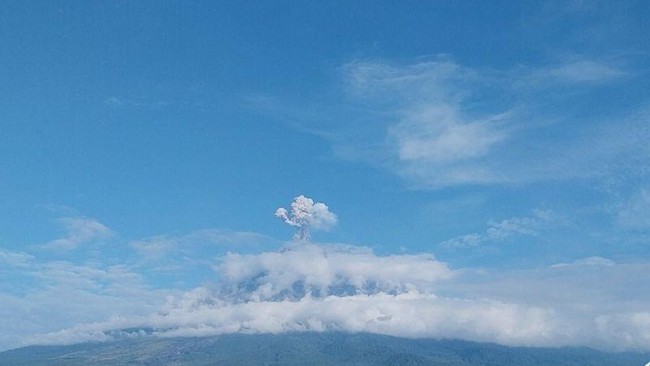
Jakarta, ThedailyID — Mount Semeru erupted four times within three hours on Tuesday morning, sending volcanic ash as high as 1,300 meters above its summit and prompting authorities to renew safety warnings for nearby communities.
Head of the Semeru Volcano Observation Post, Liswanto, said the first eruption occurred at 5:39 a.m. WIB. It produced an ash column reaching 1,300 meters above the peak, or about 4,976 meters above sea level.

Observers saw white-to-gray ash drifting north at moderate intensity.
The second eruption followed at 6:29 a.m., producing an 800-meter ash column. Meanwhile, the third eruption occurred at 6:51 a.m. and sent ash 1,200 meters into the air.
The volcano erupted again at 7:55 a.m., with the fourth event producing a 1,000-meter ash column. Seismographs recorded a maximum amplitude of 22 millimeters and a duration of 100 seconds.
Authorities urged residents and tourists to avoid all activities within the 13-kilometer southeastern sector along Besuk Kobokan, which remains highly vulnerable to volcanic hazards.
In addition, officials warned people to stay at least 500 meters away from riverbanks beyond that zone. They said hot clouds and volcanic mudflows could travel as far as 17 kilometers from the summit.
Liswanto also reminded the public to avoid areas within a 5-kilometer radius of the crater because of the risk of incandescent rock fragments.
Furthermore, he warned residents to remain alert for hot clouds, lava flows, and lahars along rivers originating from the volcano. These include Besuk Kobokan, Besuk Bang, Besuk Kembar, and Besuk Sat, as well as smaller tributaries connected to Besuk Kobokan.
So far in 2026, Mount Semeru has erupted 1,486 times. As of 9:20 a.m. WIB on Tuesday, authorities maintained the volcano’s status at Level III (Alert).
Data from Indonesia’s Center for Volcanology and Geological Hazard Mitigation (PVMBG) showed the volcano recorded 16 eruption earthquakes between 12:00 a.m. and 6:00 a.m. WIB on Tuesday.
Meanwhile, monitoring stations also detected three avalanche earthquakes and two emission earthquakes during the same observation period.